
Walk into any toy store and you’ll see the words “educational toys” on half the boxes — but what actually makes a toy educational, which ones genuinely help at each age, and which are just plastic with a clever label? This is the complete guide to educational toys for kids in India: what the research says, how to choose by age and skill, what to avoid, and how to build a small collection that truly teaches.
What makes a toy truly “educational”?
A genuinely educational toy has one clear test: the child does the thinking, not the toy. Child-development researchers consistently find that the best learning happens with toys that are “90% child, 10% toy”. That gives us four markers:
- Active, not passive — the child builds, fits, sorts, speaks or solves; the toy doesn’t perform for them
- Self-correcting — a puzzle piece fits only its own slot, so the toy teaches without an adult hovering
- Open-ended — it can be played with in more than one way, so it grows with the child
- Just hard enough — a small stretch beyond what the child can already do keeps them hooked without frustration
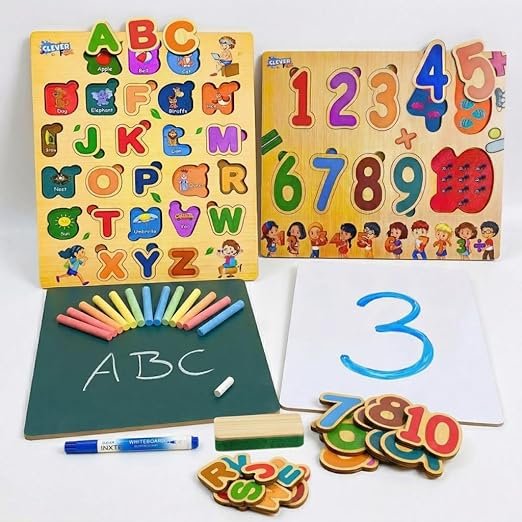
By this test, a plain wooden alphabet puzzle is deeply educational, while a tablet-toy that sings the ABC song is mostly entertainment. The singing toy performs; the puzzle makes the child perform.
Educational toys by age: what to buy when
0–12 months: senses first
Newborn vision is blurry and loves contrast. High-contrast flash cards build visual focus in the first months, graduating to colours and real-world objects by the first birthday. Keep everything large, soft-edged and chewable-safe at this age.
1–2 years: hands get busy
Stacking, posting, knocking down, fitting — this is the age of cause and effect. Chunky wooden toys with big pieces are ideal: they survive throwing and give real sensory feedback that plastic can’t match.
2–4 years: letters, numbers and make-believe
The golden window. An ABC puzzle board starts as shape-matching and becomes letter recognition; a 1–10 counting puzzle makes numbers physical; stamp-art kits feed the creativity explosion. We’ve written a full guide to educational toys for 2–4 year olds.
4–7 years: school skills through play
Now toys can carry real curriculum weight — phonics, addition, geography — while still feeling like play. Tangram shapes build geometry sense, fraction sets make maths visible, and chalkboard puzzles bridge from recognising letters to writing them.
5–10 years: knowledge toys
Older kids love toys that make them feel knowledgeable. Our bestselling India map puzzle teaches all 28 states and capitals through state-shaped pieces — the kind of knowledge that earns applause at family dinners and quietly helps in school for years.
How to choose: a 5-point checklist for Indian parents
- One clear skill. Ask “what will my child practise with this?” If the box can’t answer in one phrase, skip it.
- Materials you’d trust in a mouth. Smooth-edged wood, child-safe non-toxic colours, and for under-3s, pieces too big to swallow.
- No batteries for under-5s. If the toy performs, the child spectates. Silence is a feature.
- Three-ways test. Can it be played with in at least three different ways? Then it will survive beyond the first week.
- Made-in-India advantage. Local brands design for Indian contexts — Hindi varnamala, Indian states, Indian animals — which imported toys simply don’t cover.
The 80/20 of educational toys
You don’t need forty toys. Research on toddler play shows children play longer and more inventively with fewer toys available. A rotation of 8–12 good ones — a letters toy, a numbers toy, a creativity kit, a knowledge puzzle, something for quiet time — with only 3–4 out at once, beats a heaped toy box every time. Our guide to Montessori-style wooden toys shows how to build that starter shelf.
Try before you buy: free learning games
Want to see how your child responds to letters, numbers or geography before buying the toy? We build free online learning games — phonics, counting, India states & capitals and our new Bolo Cards speaking game — no ads, no sign-up. Ten minutes of play tells you exactly which skills your child is hungry for; the matching toy in our educational toys store cements it offline.
Frequently asked questions
What are educational toys?
Educational toys are toys designed so that playing with them practises a real skill — letter and number recognition, counting, fine motor control, logic, geography or language — rather than just entertaining. The defining feature is that the child actively does the thinking.
Which educational toys are best for Indian kids?
Alongside universal classics like alphabet and number puzzles, Indian kids benefit hugely from India-specific toys — India map puzzles for states and capitals, and bilingual English + Hindi learning cards — because they match what school will actually ask of them.
At what age should I start educational toys?
From birth — high-contrast cards are an educational toy for a 2-month-old. The toy just changes with the age: senses first, hands next, letters and numbers from around 2, and knowledge toys from 5.
Are expensive educational toys better?
No. Price usually buys electronics and licensing, not learning value. A ₹200 wooden puzzle that makes a child think beats a ₹2,000 talking tablet that thinks for them.