
Between 2 and 4 years, a child’s brain forms connections faster than at any other time of life — which is exactly why this is the age when toy choices matter most, and when most toy boxes fill up with flashing plastic that holds attention for a day. This guide covers the best educational toys for 2–4 year olds in India, what skill each one actually builds, and how to choose fewer, better toys.
What a 2–4 year old actually needs from a toy
Child-development research keeps arriving at the same answer: at this age, the best toys are “90% child, 10% toy”. A toddler pushing a puzzle piece into place is building fine motor control, shape recognition, patience and vocabulary all at once. A toy that sings and flashes does the work for the child — and teaches far less. Look for toys that are:
- Open-ended — can be played with in more than one way
- Self-correcting — the puzzle piece only fits one slot, so the toy itself teaches
- Tactile — real textures like wood and foam beat touchscreens for sensory development
- Just hard enough — a small stretch beyond what they can already do
Our picks, by skill
For letters: Wooden ABC Alphabet Puzzle
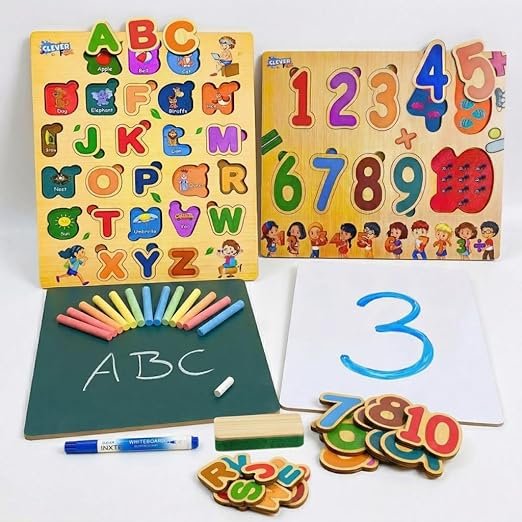
The wooden ABC puzzle board is the classic first alphabet toy: 26 chunky letters, each fitting its own slot. At 2, it’s a shape-matching game; at 3, they’re naming letters; at 4, they’re spelling their name with the pieces. If you want a version that grows further, the 2-in-1 ABC puzzle and chalkboard adds a drawing board and a phonics guide for parents.
For numbers: Wooden Number Puzzle (1–10)
Counting fingers is abstract; holding a wooden “3” is not. The Montessori counting puzzle makes numbers physical objects a toddler can grip, stack and slot. The 3-in-1 number puzzle with chalkboard adds tracing practice for the pre-writing stage.
For creativity: Safari Stamp Art
At this age kids want to make things. The Safari Stamp Art kit lets them stamp jungle animals and colour their own stories — structured enough that they can finish something, open enough that every picture is different.
For logic and quiet play: foam tangrams and Magic Circles
The water-sticking foam tangram shapes turn bath time into shape-building time — they stick to tiles with just water. Magic Circles (240 foam buttons) are the quiet-time hero: patterns, counting, colour sorting, and no noise.
A simple rotation trick that doubles every toy’s life
Keep only 3–4 toys out at a time and store the rest. Swap them every week or two. A toy that’s been “away” for ten days is a new toy again — and a small shelf of rotating toys holds attention far better than a heaped toy box. This is also why buying fewer, better toys works: five great toys on rotation beat twenty forgettable ones.
Free companion games
We build free browser games that pair with hands-on play — try the Alphabet Adventure phonics game or Number Land counting games for a rainy-day treat. Ten minutes of game, then back to the real puzzle — the game introduces, the toy cements.
Browse the full range for this age in our toys for 2–4 year olds collection, or see everything in the store.
Frequently asked questions
How many toys does a 2–4 year old need?
Fewer than you think. Research on toddler play consistently finds children play longer and more creatively with fewer toys available. A rotation of 8–12 good toys, with 3–4 out at a time, is plenty.
Are wooden toys really better than plastic?
Wood offers weight, texture and durability that thin plastic can’t match, and wooden toys tend to be open-ended rather than battery-driven. That said, quality EVA foam has its own advantages for bath play and travel — material matters less than whether the toy makes the child do the thinking.
When should my child start alphabet puzzles?
Around 2 years as a shape-matching game, with letter names coming naturally between 2.5 and 3.5. There’s no rush — the matching and gripping practice is valuable long before the letters mean anything.